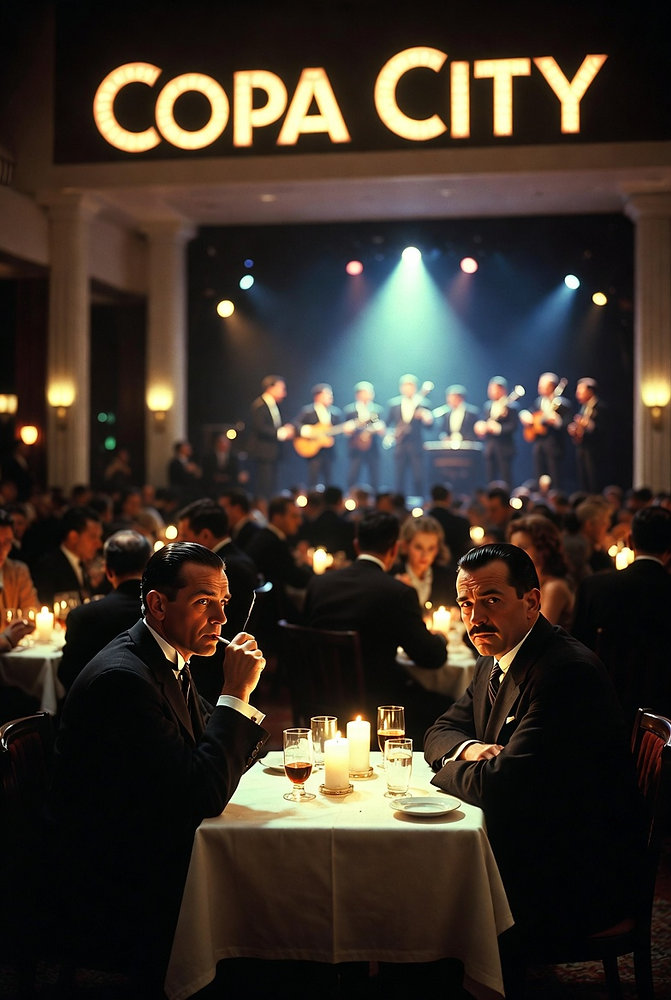
1949. The Copa City Nightclub had operated since 1944. The building was located on the prominent corner of Dade Boulevard and West Avenue. Its exterior spoke to the Art-Deco craze of the period. Performers were as culturally varied as the city's inhabitants. Artists like Josephine Baker, Desi Arnaz, and Dean Martin performed regularly for crowds that appreciated creativity.
The building's original configuration was completely destroyed in June 1948. There had been an initial attempt by the two invaders to destroy Miami's hub of multiculturalism. Determination overcame arson that destroyed the structure. Six short months later the business re-opened to massive demand.
The club's interior was dark; lit mostly by candles centered on each table. Large, round, white columns were sporadically spaced about the room. The stage at the front of the room was small. Interactions between performers and patrons were intimate.
Pressed white tablecloths were draped beyond edges of the round surfaces they covered. Men were smartly dressed in black slacks, white tuxedos and black bowties. Women wore evening gowns; some strapless and others with the slightest hint of material. Silk strands were less about support, and more about accentuating ever so supple spaces between collar-bones and shoulders. The venue, and the evening's participants, embodied class.
There were no exits from the stage to dressing rooms. Performers accessed the stage by walking through the crowd; stopping to shake hands, greet friends, and thank patrons for attending shows. Relationships were approached respectfully.
Linear rows of tables adorned the back and sides of the Copa Room. Tables on the floor were scattered about evenly; requiring servers and entertainers to snake their way toward destinations.
Hochstühl and Von Unterscheisse occupied a table in the middle of the floor; a prime, in-demand position. Money flowed freely into their businesses. Wealth afforded them access to classier venues in town. They were there that night to enjoy Desi Arnaz and his Cuban Orchestra.
"This reminds me of the clubs in Paris during the war," the younger man reminisced.
Hochstühl nodded. "The music is better in Europe. These people are mere animals who luckily string together a few notes and bars."
Von Unterscheisse felt his boss' critique a bit harsh. "Yes, but it seems to embrace life a bit more than in Europe."
The General looked skeptically at his subordinate without comment.
The Colonel doubled down. "You know, they seem to have a more human connection here than back home."
"That's because we have strong music; Oompa music. It's what's needed to march into war and potential destruction." The General flicked the back of his right hand toward the stage. "This weak music resonates happiness within these people." He scoffed and inquired rhetorically. "Who has time for joy?"
"Regardless, I appreciate you bringing me here tonight."
"We're not here for entertainment. This evening is about defining the enemy, and our ultimate strategy of divide and conquer."
"Divide? How?"
"Look around the room."
The Colonel silently and visually scanned the faces of club-goers. He shook his head gently. "Everyone seems well-dressed; happily anticipating the show."
"And?"
"And what? That's all I see."
"Look deeper."
The Colonel continued shaking his head; incapable of grasping the General's message.
"Skin deeper."
"Oh," he exclaimed. "I see it now."
"Exactly. Cubans. Puerto Ricans." He paused before continuing disgustedly. "Schwartz. There's even a Hasidic Jewish couple near the stage."
"They're all dressed quite nicely and appear well-to-do."
The General inhaled deeply. "And they are all here…together." He shook his head. "That's what our mission will be over the next few decades. This club, and others like it, must be destroyed. We cannot have people of different persuasions to…inspire one another."
The men's conversation was interrupted by house lights dimming. A hush fell over the crowd. A spotlight illuminated a circular space at the rear of the room; into which Desi Arnaz stepped.
The entertainer began winding his way through the tables on the main floor.
The two men expressed disdain for that which was not German by continuing to face the stage; keeping their backs to the band-leader as he approached.
As if divinely inspired, Desi stopped at the men's table and offered a brief greeting. He shook both of the Nazis' hands. "Welcome to the show, gentlemen."
Colonel Von Unterscheisse offered a smile.
The General glowered.
Undaunted, the entertainer continued toward obligation. Mr. Arnaz hopped onto the stage and thanked the crowd for attending his show.
General Hochstühl seethed the entire evening.
The two men occasionally attended shows at the Copa. Sadism drove the senior officer to the point of torture. No finer manner existed for the man to stoke hatred of humanity; it was that destructive resonance that brought life's intensity to an otherwise vapid human.
There was no more apropos example of how far American society fell than Desi Arnaz. The band-leader's nightclub schedule was greatly reduced when he and wife Lucille Ball began their six-year run on television in 1951. The entertainer's talents were taken from people who enjoyed them in intimate and personal settings. The man's vibrance, that which was shared with others, was reduced to that of a two-dimensional, black and white, six-inch tall marionette.
Inspiration was systematically removed from local communities.